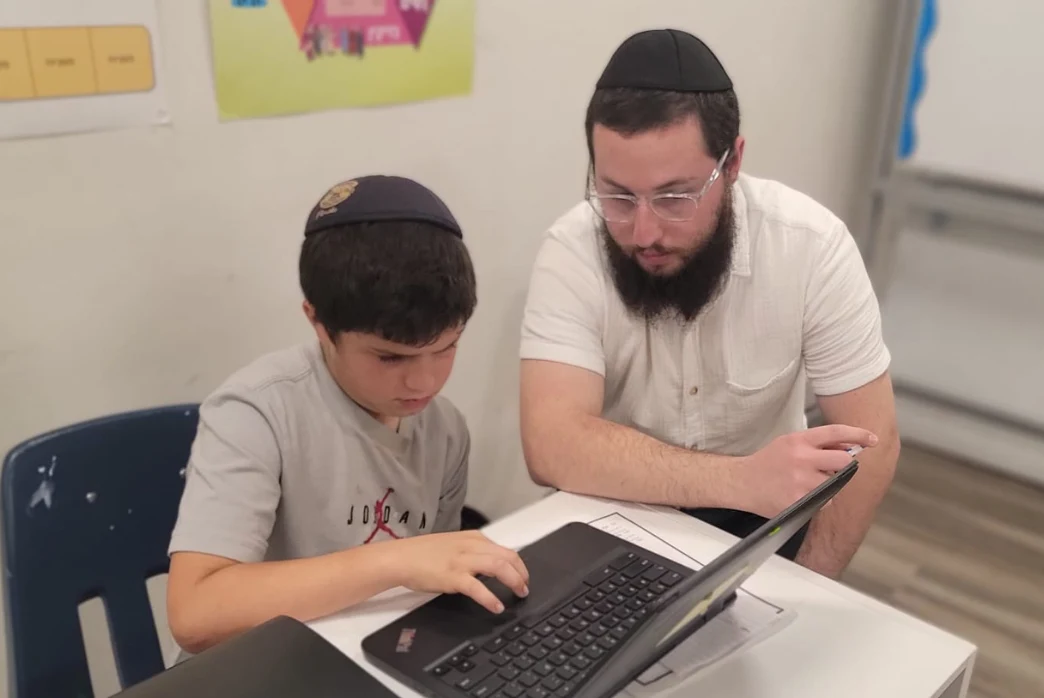
Inspired Torah Schoolhouse begins with connection, individual strengths, and Torah values. Step into six ordinary classroom moments and explore how a thoughtful response can open a door.
Choose a response to see what it could make possible. There is no score: context matters, and several responses can work together.
Illustrative situations created to explain the philosophy. These are not actual student stories, individualized advice, or a formal staff-training protocol.
0 OF 6 MOMENTS EXPLORED
01
A DIFFERENT WAY IN
THE ANSWER IS DRAWN, NOT WRITTEN.
During a math task, a child draws a careful picture instead of using the written method. What would you want to understand first?
CHOOSE AN IDEA ABOVE. EXPLORE THE THINKING BELOW.
READ THE THINKING BEHIND ALL THREE RESPONSES
ASK THE CHILD TO EXPLAIN THE DRAWING.
An explanation can reveal the mathematical thinking already there. Ask where the quantities are and how the child knows the answer.
MODEL THE WRITTEN METHOD.
A model can help. First connect it to the child’s drawing, so the new notation represents an idea the child understands.
OFFER OBJECTS TO WORK WITH.
Objects may make an abstract idea tangible. Watch whether the child can connect the objects, drawing, and symbols.
WHAT WE NOTICE
A strategy may be different and still show real understanding. The useful question is what the child understands and what needs teaching next.
WHAT A RESPONSE COULD LOOK LIKE
Invite the child to explain, then bridge that thinking to the next skill. Keep the learning goal clear while making room for an individual route.
WHAT GROWTH MIGHT LOOK LIKE
Look for a clearer explanation or a connection between two ways of showing the same idea. These are signs to observe, not a promised outcome.
A child pushes a reading page away after trying a difficult word. Where might you begin?
CHOOSE AN IDEA ABOVE. EXPLORE THE THINKING BELOW.
READ THE THINKING BEHIND ALL THREE RESPONSES
ACKNOWLEDGE THE FRUSTRATION.
“That felt hard” can open a conversation. A calm connection helps you find out which part became difficult.
MAKE THE NEXT STEP SMALLER.
Try one sound, one word, or a shorter line. A small step should still teach something meaningful.
ASK WHAT ALREADY HELPED.
The child may remember a cue or strategy that worked. Naming it builds a more useful story than “I’m just bad at this.”
WHAT WE NOTICE
A difficult moment is information. It may point to a skill that needs teaching, a task that needs adjusting, or a child who needs a moment of connection.
WHAT A RESPONSE COULD LOOK LIKE
Reconnect, identify a teachable step, and practise it together. Keep encouragement specific to what the child did and the strategy used.
WHAT GROWTH MIGHT LOOK LIKE
Watch for a useful strategy, a fresh attempt, or greater independence. If the approach is not helping, adjust the support rather than repeating it louder.
Two children both want the same art material. The voices get louder. What could come first?
CHOOSE AN IDEA ABOVE. EXPLORE THE THINKING BELOW.
READ THE THINKING BEHIND ALL THREE RESPONSES
HELP BOTH CHILDREN PAUSE.
A calm pause makes room to hear each other. If anyone might get hurt, safety comes first.
HEAR EACH CHILD’S IDEA.
Each child may have a different plan for the material. Hearing those plans can reveal more possibilities than deciding who is “the difficult one.”
HELP MAKE A FAIR PLAN.
A turn, a timer, or another material may help. The plan needs to respect both children and be something they can follow.
WHAT WE NOTICE
Both children have an idea that matters. Both also need practice considering another person. Ahavas Yisrael has a place in this ordinary classroom moment.
WHAT A RESPONSE COULD LOOK LIKE
Help the children name what happened, listen, and make a workable plan. Support repair if someone was hurt or something was damaged.
WHAT GROWTH MIGHT LOOK LIKE
Look for a more respectful request, a kept agreement, or a thoughtful repair. Connection and clear expectations can grow together.
A child sees that a classmate has no pencil and quietly offers a spare. How might you respond?
CHOOSE AN IDEA ABOVE. EXPLORE THE THINKING BELOW.
READ THE THINKING BEHIND ALL THREE RESPONSES
NAME THE THOUGHTFUL ACTION.
“You noticed what your friend needed” helps the child recognize the care in a specific action.
ASK HOW IT HELPED.
A short reflection can connect the deed with its effect on another person, without turning the recipient into a public lesson.
CONNECT IT TO AHAVAS YISRAEL.
Use language the child understands: caring for another Jew is something we can put into action today.
WHAT WE NOTICE
The child has noticed someone else and acted. A small moment can express a Torah value in a concrete way.
WHAT A RESPONSE COULD LOOK LIKE
Acknowledge the action with warmth and respect for both children. Make space for the meaning of the mitzvah rather than only the recognition.
WHAT GROWTH MIGHT LOOK LIKE
Watch for growing initiative and care. The mitzvah itself matters; this example is not a points rule or an instruction to report someone else’s activity.
What is Inspired Torah Schoolhouse’s educational philosophy?
Inspired Torah Schoolhouse in Boca Raton centers connection, personalized instruction, individual strengths, and meaningful growth in Yiddishkeit. Torah values shape learning and relationships.
How does the school approach differences in learning?
The approach begins with getting to know the child and the thinking behind the work. These examples show ways an educator might connect a strength to a clear learning goal, adjust a task, or offer another route into understanding.
Does connection mean removing expectations?
Connection and responsibility belong together. The examples pair listening and encouragement with explicit teaching, workable boundaries, and care for other people.
Are these real classroom cases or official teacher-training materials?
No. The six moments are illustrative explanations of the philosophy, not actual student stories or a formal training protocol. Ask the school about current classroom practice, teacher development, and the support available for your child.
LET’S MAKE IT PERSONAL
WHAT WOULD HELP YOUR CHILD GROW?
Bring your questions, your hopes, and the things you love about your child.